Three months after my first visit, I returned to Focu Sauvage to see how this much-discussed project by Jordan Tseneklidis and Panagiotis Siafakas had evolved. I found it almost exactly as I had left it: packed, lively, thoroughly enjoyable, and already firmly established as one of the restaurants shaping the city’s culinary conversation.
This time we sat outside, on an evening when autumn had begun to show its teeth, and there was something striking about seeing this remarkable group, who spent years cooking beneath the open sky, now framed by Kerameikos, apartment blocks, city lights, and the noise of Athens. Because, however much the setting has changed, the world of Nomade et Sauvage is still very much present. Only now, instead of dry grass, rocks, scrub, and earth, there is stone, aged wood, and metal. Instead of a fire burning in the middle of nowhere, there are hearths blazing inside a building almost a century old.
Rather than appearing for a single night and disappearing again by morning, it now has a permanent address in the heart of the city. And that remains the thing that fascinates me most about Focu Sauvage.
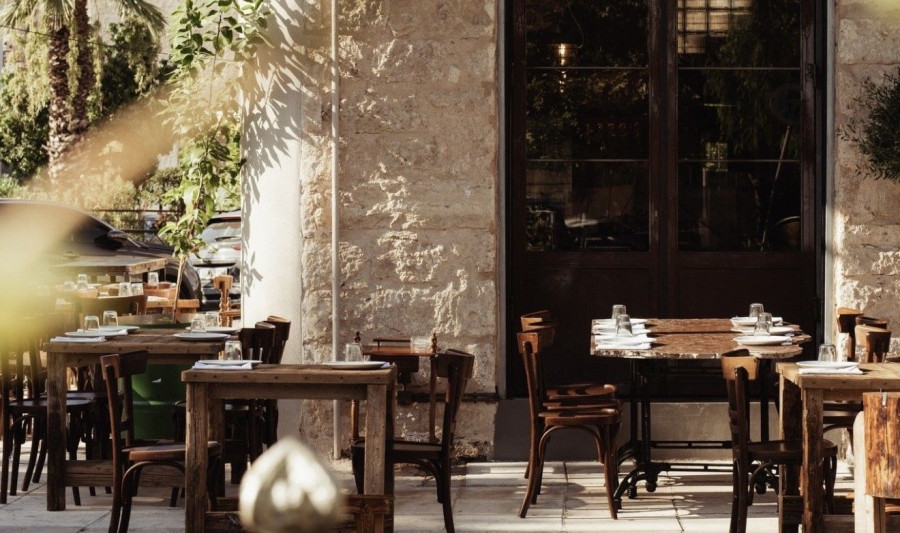
Jordan Tseneklidis and Panagiotis Siafakas took years of their lives, images of mountains and fields, smoke, outdoor cooking in cauldrons and over open fires, long tables gathered around the flames, and brought all of it to the capital without allowing it to feel like a reconstruction of their former life. Instead, they let those elements settle into the building as though they had always belonged there. That perhaps explains why the interior remains so compelling: part workshop, part old cookhouse, part refuge, with objects everywhere that seem to have had a practical life before acquiring any decorative value. Downstairs, in the cellar, the atmosphere becomes even more concentrated. The long monastic table, the candle stand, the wine cabinets, the stone and the low lighting create an almost ritualistic setting. Three months on, Focu Sauvage, which also includes Tasos Fanariotis, Kostas Bletsas and architect Giannis Kavourtis among its business partners, still has its own world, its own language and, above all, its own visual identity. And this is where the most interesting part begins: what has happened in the kitchen in the meantime.
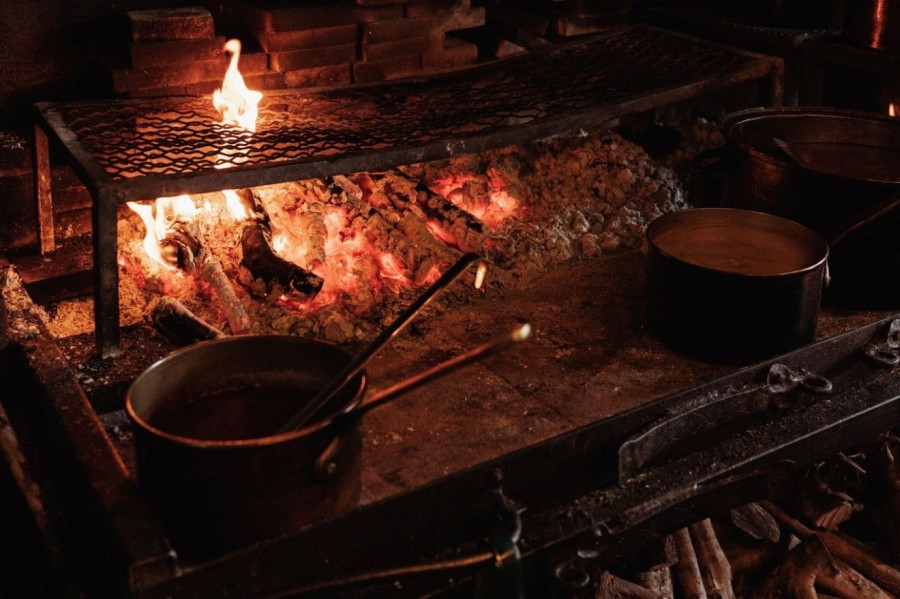
So, to the food, because this is where everything is ultimately decided. At Focu, the cooking begins with fire, quite literally. Nothing here waits for the flick of a switch: wood is lit, iron is heated, cast-iron pans and pots are brought up to temperature, stoves and wood-fired ovens are put to work, a pot is left to take its time, or something is placed almost bare over the embers. There is something elemental about this kitchen, almost a return to a way of cooking in which heat does not arrive with decimal-point precision and the cook has to watch, smell, wait, and understand when the fire has flared up and when it has settled into glowing embers.
Onto that canvas go predominantly Greek ingredients and flavours that feel familiar to all of us in one way or another: pulses, vegetables, wild greens, meat, fish, doughs, olive oil, things that can go into a pot, cook slowly in a heavy vessel, char, smoke, or develop that particular sweetness that only comes from spending a long time close to the fire. And that is what I like so much about Focu. Behind all the theatre of flames, timber and blackened iron, the food remains deeply Greek and reassuringly familiar at its core. It simply passes through the hands of people who have spent years cooking outdoors and have learned to treat fire almost as another ingredient in the recipe.
Compared with my first visit, just two days after the restaurant opened, I found the cooking clearly improved and beginning, little by little, to find its footing, which, to be honest, is exactly what I expected. Is there still room for improvement? Absolutely. Some dishes could use another layer or two of intensity, while the seasoning here and there still needs slightly better judgement. But there are also dishes at Focu that are impossible not to admire.
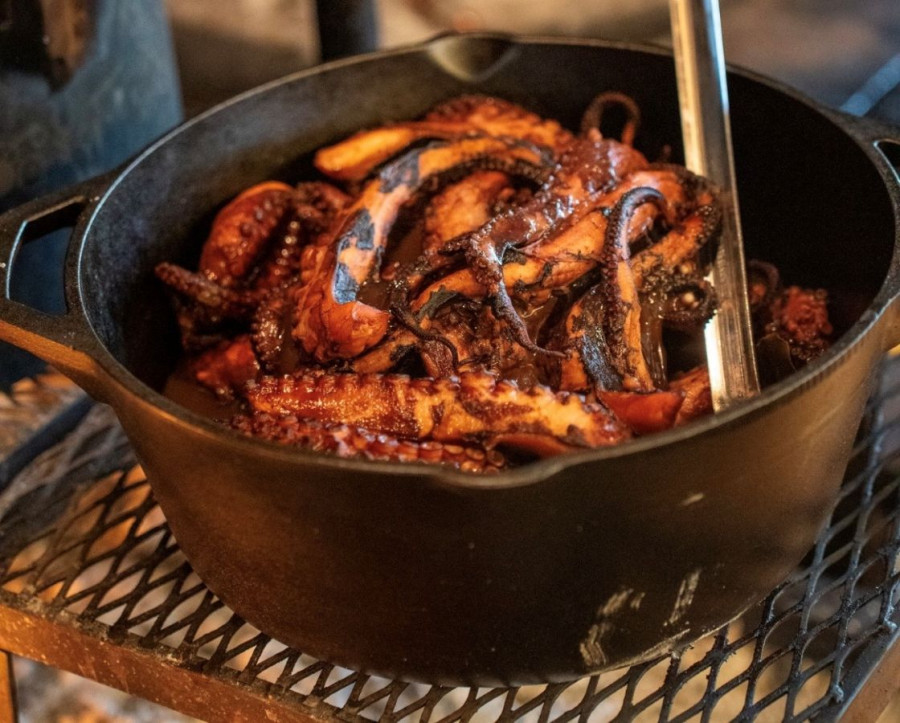
I will go straight to the fire-cooked calf’s liver, one of the highlights of the meal, with a rich ladolemono sharpened by exactly the right amount of acidity. It was genuinely superb. Then came one of the best octopus dishes being served in Athens right now, if not the best. Cooked as a stifado in a traditional shallow metal pan, it was meltingly tender while still retaining structure and character, a world away from the soft, lifeless texture octopus so often takes on when it is overcooked. The smoked cod was also excellent, served with superb tsaoulia green beans that very nearly stole the show and ultimately became equal partners on the plate. Their pasta with minced meat is pure comfort. The sauce leans just a touch sweeter than it should, though, so I would strongly recommend being generous with the cheese. It gives the dish exactly what it needs and lifts it considerably. The slow-cooked kid goat with orzo is another dish with plenty to say: rich, warming, proper food, the kind you want to eat with a fantastic bottle of wine alongside.
Among the dishes that still need a little calibration, I would include the wood-fired beetroot and carrots. They were undeniably sweet and delicious, but also somewhat muted. They need a small jolt of excitement, something to lift them just a notch. The same applies to the grapes cooked in cast iron with cucumber and an exceptional soft feta. It is an interesting idea, playful and with plenty to say, but a little more acidity, or something to cut through the sweeter notes of the dish, would make it even better.
This time, their unconventional baklava, rolled like a wrap, arrived with undercooked pastry and a filling that felt slightly dry. The “Zarki” galatopita, however, with butterscotch and vanilla ice cream, was fantastic and brought the meal to exactly the kind of finish such a strong kitchen deserves.
As the evening drew to a close, it would have been an omission not to mention the talented sommelier Giorgos Karampinis, who oversees a genuinely impressive wine list with a perspective that extends well beyond the Greek vineyard, and at remarkably sensible prices. Focu is also fortunate to have Giannis Toris as restaurant manager, one of the most charismatic figures you are likely to encounter in a Greek restaurant today. We do not exactly have an abundance of people like him.