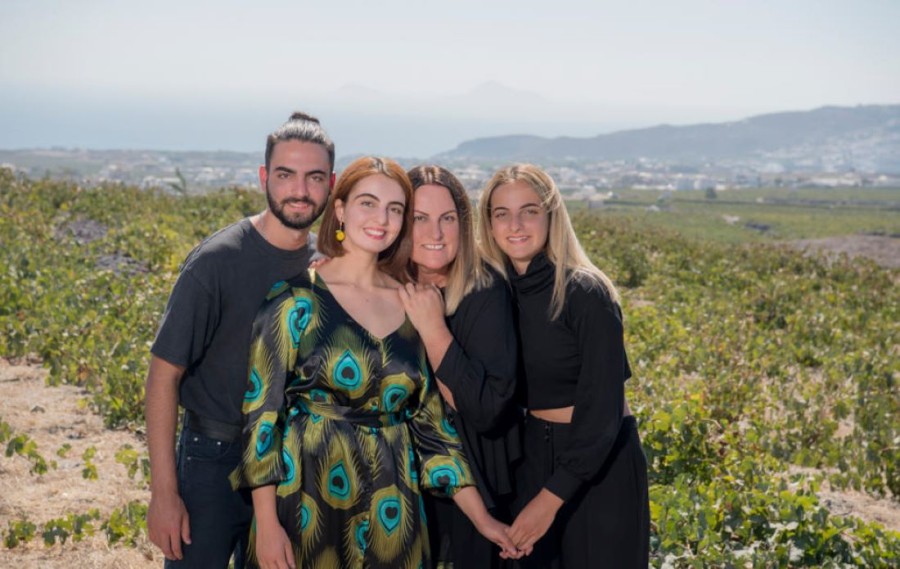
I`ve often expressed my firm belief that the winery founded in 1997 by Haridimos Hatzidakis and Konstantina Chrysou has never lost its impressive pace — even after the tragic and unexpected passing of the renowned winemaker in 2017.
Over the past seven years, I’ve had many opportunities to reinforce this view, but none has been as overwhelming as the most recent, which covered almost all of the winery`s post-Haridimos work.
The Prelude is the 2024 Aidani (8/10), a recent vintage of a distinctive cuvée — the first produced by the ‘mountain’ (for Santorini!) winery in Pyrgos. It’s vibrant in aromatic expression, with notes of honeysuckle, and presents a rounded, spicy profile that offers a lasting sense of calm before an imminent storm.
The Santorini Familia is the flagship label of the winery, crafted from grapes grown by growers in Pyrgos and Akrotiri, who are considered family to the estate. The 2024 vintage (8.5/10) is still young, showing a dominant mineral character, but it also offers a rich, long-lasting profile without a hint of tannins.
It takes about five years for the Familia to reach a good, mature stage, with the 2023 (8/10) needing roughly 2-3 years less. Despite its aromatic botanical notes, the 2023 feels warmer, more tannic, and more compact compared to the impressive ’24. The 2022 (8/10), although from a highly praised year, I personally found quite developed and filled with petrol memory. If I had to choose a vintage to enjoy Familia now, this would be the one!
The next stop on this journey through… the family vintage left me pondering, especially since the 2020 (?/10) was incredibly powerful both in flavour and aromatic complexity. Time will tell whether this “ugly duckling” will transform into a swan in the future, but there are no doubts in the case of the superb 2018 (9/10). Petrol notes and smoky mineral nuances are entwined with nuts, creating a calm yet remarkably long finish that captivates the senses.
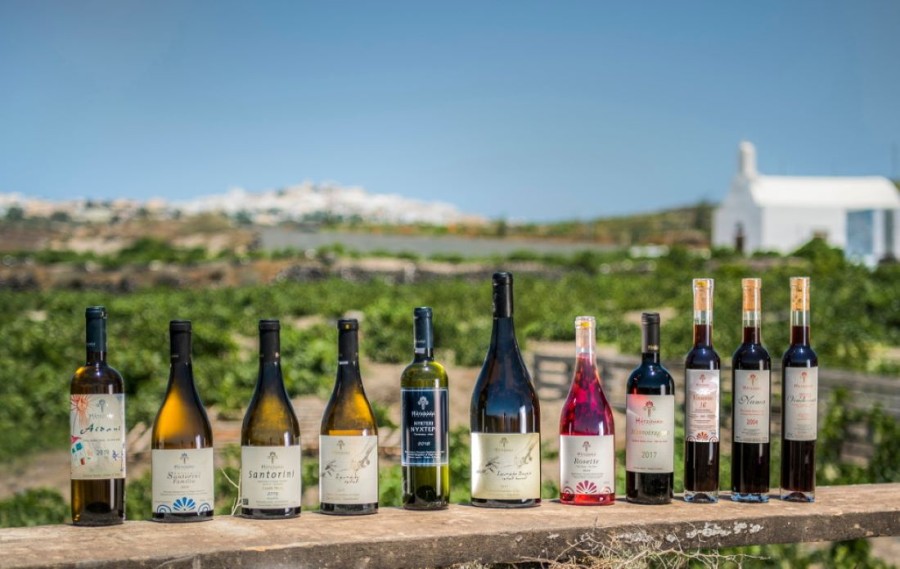
The legacy left by Haridimos and the baton passed to his children is embodied in Skitali, which spends 12 months on the lees, followed by a further 6 months of barrel aging in the cellar. The 2020 (?/10) remains a point of reflection, but the 2023, 2022, and 2018 vintages (all 9/10) demonstrate remarkable length, power, and great potential for aging. The 2020 is tangy and wild, with a buttery saltiness, while the 2022 and 2018 showcase the character of the smoky mineral, rich and approachable over time. Finally, the 2018 is incredibly balanced — nutty and refined — capable of offering joy for many years to come, well into the next decade.
The rare Skitali Barrel 2021 Magnum (8.5/10) adds an additional 12 months in barrel to the previous formula, resulting in an even richer and more tannic wine. However, the dominant bread-like aroma on the nose makes me want to say—a much rarer phrase—“it needed even more barrel aging!”
Rampelia is a single vineyard Santorini wine from a vineyard plot in Pyrgos, the first fully crafted by the new team at the winery, led by Spyros Papandreou and Nektaria Vlachou. The 2022 (8/10) reveals notes of chestnut, showing the same rapid development I also observed in the 2022 Familia. However, the 2021 (9/10) is a masterpiece, showcasing a concentrated sweetness of lemon, petrol-like expressiveness, full-bodied strength, and remarkable length. Still young, it may take 5-7 years to reach the level of the `greats,` but it’s already showing extraordinary potential.
The Nikteri is one of the few labels that no longer offers the same emotional intensity of the past. Not that its overripe harvest, aged for 12 months in barrel, isn’t a superb wine — which indeed amplifies its body and tannic strength — but both the 2022 (8.5/10) and the 2021 (8.5/10) feel more like a modern barrel-aged white wine, rather than the velvety oxidised pleasure that once made it truly magnificent.
On the other hand, the “coloured” dry wines have ceased to be the Achilles’ heel of the collection and have transformed into worthy counterparts to the whites. Rosette, with its deep red hue—which might put some off at first glance—actually boasts a commanding presence, with tannic sharpness and a clear fruit profile showing pomegranate, cherry, and apple. The 2024 Rosette (8/10) reflects this with vibrant acidity, while the 2022 (8.5/10) offers a distinctive creamy texture. Meanwhile, the 2023 (7.5/10) looks for greater intensity and more pronounced fruit.
On the other hand, the “coloured” dry wines have ceased to be the Achilles’ heel of the collection and have transformed into worthy counterparts to the whites. Rosette, with its deep red hue—which might put some off at first glance—actually boasts a commanding presence, with tannic sharpness and a clear fruit profile showing pomegranate, cherry, and apple. The 2024 Rosette (8/10) reflects this with vibrant acidity, while the 2022 (8.5/10) offers a distinctive creamy texture. Meanwhile, the 2023 (7.5/10) looks for greater intensity and more pronounced fruit.
"I am darker, I am better!” shouts the Mavrotrogano 2022 (8.5/10). Although it would take another 5-10 years to fully unfold all its charm, the deep red from this rare variety is already highly expressive, rich in floral aromas. Despite its modest body, it finishes with a burst of lively acidity and tannic structure
Although all the wines had abundant acidity, the tasting left a surprisingly sweet impression. Thus, there was no need for dessert wines, but who could say no to two incredible dried nectar-like vinos? Liassimo NV (8.5/10) comes from Mandilaria grapes and is made from a blend of vintages separated by over 20 years. Dates and sage are invigorated by a strong dose of volatile aromatics, while the intensely sweet palate leads to a long, tannic finish. Even if this style isn’t your usual preference, Vinsanto 2004 (9.5/10) must be regarded as nothing short of epic! This 20-year-old delight offers a celebration of dried fig, apricot, and vermouth, with sweet and acidic play that seems to go on forever…
Even after experiencing such a comprehensive wine event — where, of course, not all 22 wines can be perfect — I find myself not only reaffirming my initial assessment but even daring to suggest that the average quality might now be higher than in the pre-Haridimos era. That said, it’s clear that the talented team has nothing to envy from the great winemaker. More importantly, the unparalleled sense of risk — a feeling that has given wines like Nikteri or my personal favourite, Cuvée No15, a dimension that’s almost impossible to describe with words. I am confident that now, with the winery firmly on its feet, the level of risk will rise again, introducing that “wild”, unpredictable edge that has been missing. This, I believe, will serve as the essential seasoning — the salt and pepper — in an already heartfelt and inspiring journey.