On the one hand, I tried not to be carried away by the delights of the menu, while on the other I found myself thinking of what I had once read in a book by Venezuelan art historian Celeste Olalquiaga (The Artificial Kingdom: A Treasury of the Kitsch Experience). She explains how kitsch operates, and how the familiarity of everyday, repetitive forms of art, and here cooking fits perfectly, allows us to retrieve from memory experiences stored either as genuine recollections or as imagined ones.
How many childhood memories, I wondered, were stirred when those irresistible double-fried potatoes arrived, half-covered in a rich cream of Epirus cheeses (galotyri and tsalafouti), or when the meatballs, made from a blend of beef and pork, were brought to the table?
 Yes, I will say it from the outset: we ordered quite a few dishes, perhaps even too many, but I will dwell on two in particular. First, the goat pasta cooked directly in a rich broth from goat sourced in Aetolia-Acarnania rather than in water, and finished with a generous grating of anthotyro from the same region. It is a dish I still remember clinging to my lips like a “languid kiss”, and I find myself marvelling at its honesty.
The second dish is worth dwelling on not only for its flavour, but also because it stands as a quiet rebuttal to those who believe that Greek cuisine is simple and requires neither knowledge nor technique. I am referring to the pie of the day, an impeccable Epirus-style Hortopita (pie) made with seasonal wild greens. It felt as though all the cook’s wisdom and care had been distilled into this “humble” pie. To begin with, it takes real effort, especially in a city, to source the knowledge needed to combine the greens properly, spinach, chard, chervil, wild fennel, nettles, leeks, spring onions and dill. But above all, it demands patience: to clean them, wash them, chop them, squeeze out their moisture, and bring them together into a perfectly balanced mixture with carefully selected Epirus sheep and goat’s milk feta, seasoned with olive oil, pepper and just the right amount of salt. Then comes the craft of the dough, made with skill, rolled out into a fine sheet and shaped into a coil, neither too tight nor too loose, so that air can circulate within it, only then does the pastry remain crisp rather than turning soggy. Finally, it must be baked with equal precision, at exactly the right temperature and for exactly the right amount of time. If, as you taste it, you can sense all of this, then tell me: who can resist the power of memory, and who really cares whether what moves them is a fantasy or a true recollection?
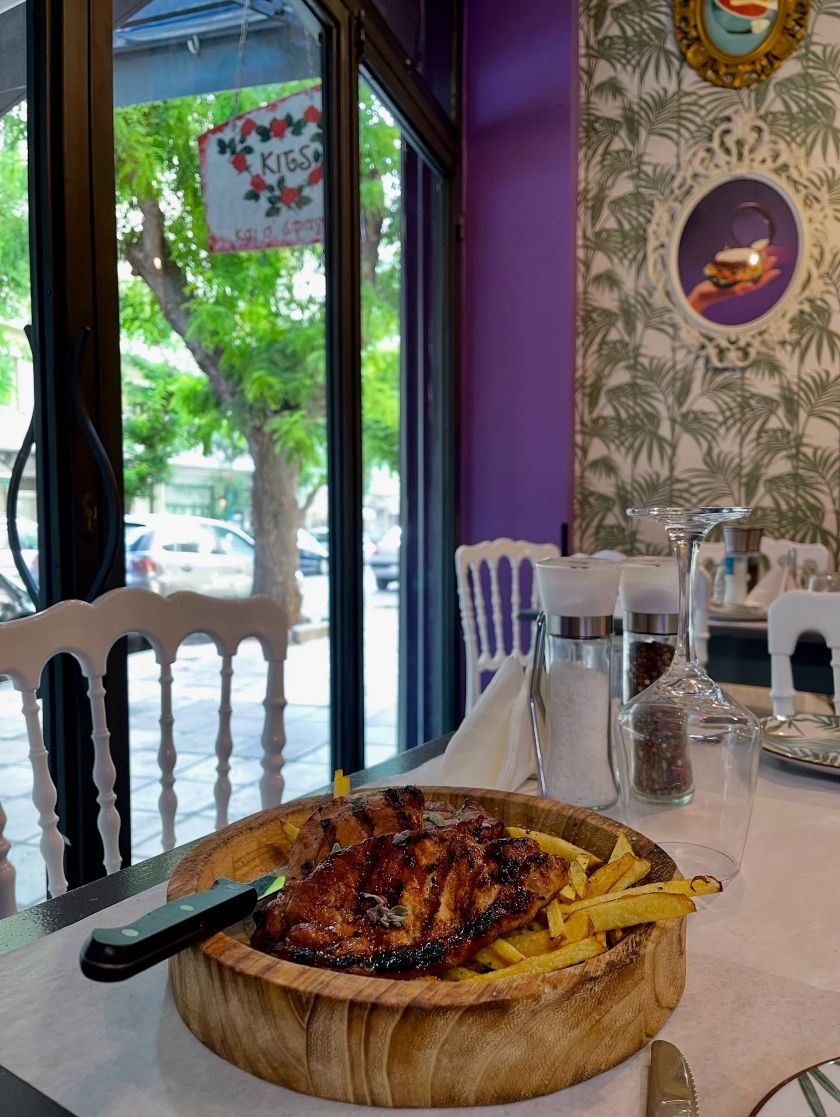
It would perhaps be unfair not to mention the other, equally indulgent dishes we tasted. Among them, the Epirus-style liver frigadeli served with sourdough flatbread and a refreshing yoghurt sauce; the lamb chop, from sheep raised in the Lakka Souli area; and the young lamb from the same region, paired with chickpeas from Kozani. That said, listing dishes from a menu that is, by nature, shaped by seasonality feels somewhat beside the point.