In 2020, the title of my first review of Lycabettus in Santorini declared that “the restaurant at Andronis Luxury Suites was at its zenith”. Six summers later, having returned once again to that terrace jutting out above the Caldera with an almost implausible beauty, and which has deservedly become one of the very few restaurant settings in Greece with genuinely global recognition, I find myself rereading that piece with a strange sense of familiarity.
It feels like looking back at an earlier version of a restaurant that continued working on itself far more than I could have imagined at the time. Lycabettus in 2020 was indeed an exceptional restaurant, perhaps the best incarnation of it I had encountered up to that point. But the path it followed gave that idea of a “zenith” a far more meaningful dimension: longevity, consistency and a steady upward trajectory that today may seem almost inevitable, even though it was anything but.
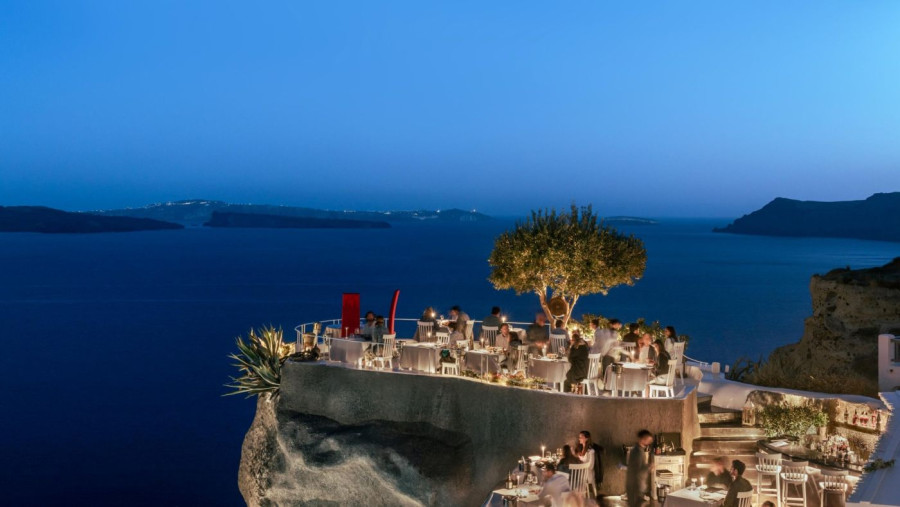
The iconic restaurant at Andronis Luxury Suites has moved through several culinary eras, changed faces and built on the work of people who each left their own mark. Throughout that evolution, Giorgos Filippidis, General Manager across the Andronis hotels, has been its most important constant, with a rare ability to read each new chapter correctly and to place his trust in the people capable of genuinely moving it forward.
Behind that journey, of course, is Miltos Andronis, one of the people who, in my view, played a decisive role in the wider reinvention of contemporary Santorini. He recognised early on that an island with such global appeal could aspire to far more, and invested persistently in hospitality, food, wine and, above all, people, gradually building an entire world around the Andronis name.
Lycabettus is perhaps the clearest expression of that vision: a restaurant that began life blessed with an almost mythical setting and managed to acquire something far more difficult to achieve, a history of its own.
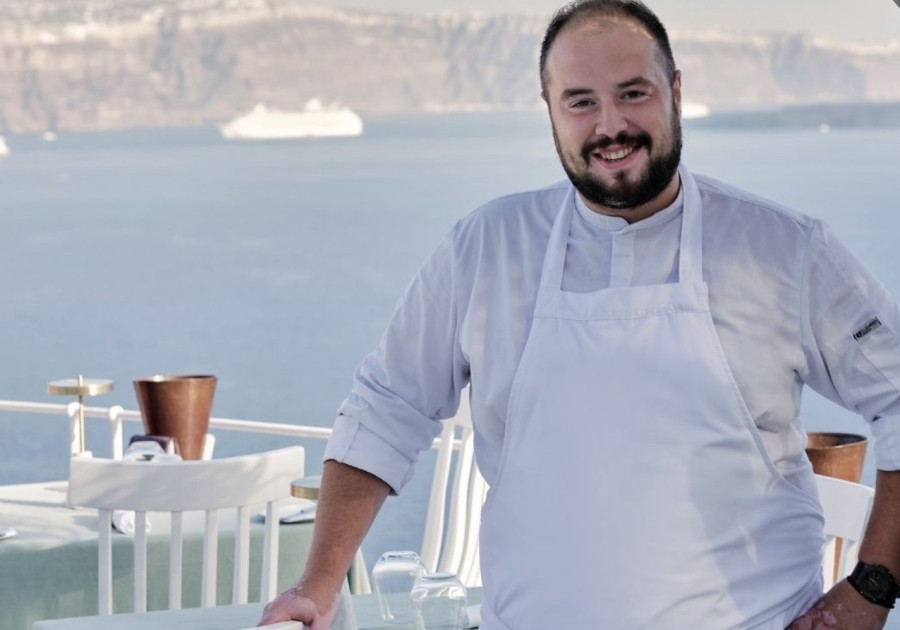
Christos Karagiannis now leads a culinary team that, in my view, has reached one of the most accomplished points in the restaurant’s history. What makes that evolution particularly interesting is that it has happened without the slightest fanfare around the chef himself. There is something I like very much about that.
We live in an age when a chef can acquire a public persona before he has really had the chance to develop a cuisine of his own, and gastronomy, which has always had a slight weakness for vanity, has found its natural habitat in social media. Karagiannis has followed a far more “old-fashioned” path: he entered the kitchen, learned, worked, took on greater responsibility, kept working and allowed the food to speak for itself.
His technical training is evident, as is his affinity with contemporary French cuisine, particularly in his sauces and in the way he builds flavour around a central ingredient. Where I see the greatest progress today is in the freedom with which he now handles all of those tools.
This year’s meal makes all of the above almost irritatingly easy to argue, because at several points the standard of the cooking is such that you genuinely find yourself doing a double take.
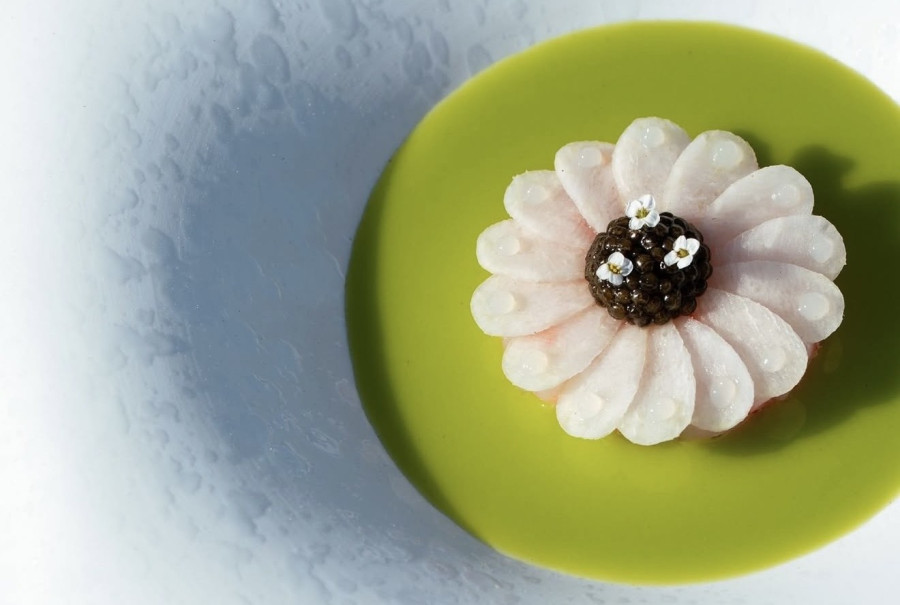
Take the tomato soup, for example, with tomato sorbet, cherry tomatoes and an excellent tomato dashi. It approaches the ingredient through different temperatures and textures, yet brings it to the palate with such clarity that the dish feels almost self-evident, which usually means that a great deal of work has gone into making it seem that way. In the red shrimp tartare, cucumber and jalapeño provide exactly the freshness and faint electric kick needed to offset the sweetness of the shellfish, while kohlrabi and caviar complete a dish that is at once refined and deeply satisfying, without a trace of excess.
It is one of those moments when fine dining finally remembers that all the technique, the extraordinarily expensive ingredients and the endless hours of work in the kitchen are ultimately meant to lead to one thing: making you want just one more spoonful.
I find the squid even more impressive. Red mullet sauce, lardo di Colonnata, Espelette pepper, caviar and an excellent shellfish sabayon come together in a combination that could easily sound excessive on paper, yet on the palate is almost disarmingly coherent. Everything works to give the squid greater depth, a more pronounced marine character and a fuller, fleshier texture. It is at moments like this that you realise just how confidently Karagiannis now commands his technique.
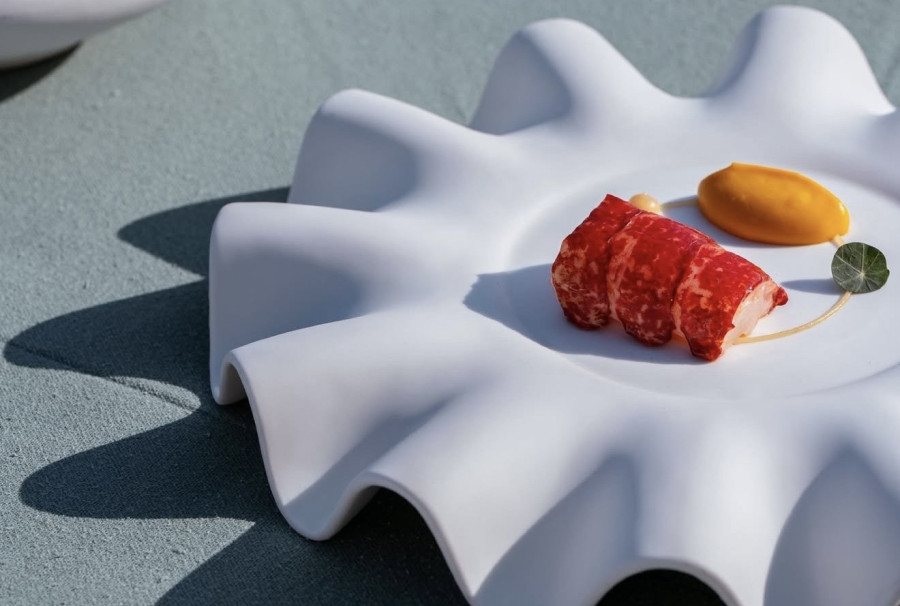
The lobster maintains the same high standard, and here the cooking is genuinely exemplary. The flesh is succulent, firm and full of that natural sweetness so easily lost when the product is taken even slightly too far. A carrot purée with bergamot and lemon and an intense, aromatic lobster sauce complement it beautifully, while the bomba rice that follows, with sobrasada and saffron, has something almost sinful about its richness, yet remains entirely refined. It is one of those moments when fine dining finally remembers that all the technique, the extraordinarily expensive ingredients and the endless hours of work in the kitchen are ultimately meant to lead to one thing: making you want just one more spoonful.
And then comes Georgios Platinos, who, for me, moved beyond the category of “excellent pastry chef” years ago. He is the best in Greece, and one of those rare people who have developed an entire language of their own around dessert. We first came to know him through the great school of the legendary Spondi, and, apart from a brief spell at The Zillers, his name has been closely associated with Andronis for several years now. I like it when a long tasting menu reaches dessert and still has something left to say. Platinos does exactly that, working with flavour with great precision and allowing his technique to show only where it needs to, without turning dessert into an architectural model that merely happens to be edible.
On the wine side, Amanda Kontinou gives a genuinely impressive performance, combining deep knowledge with a wonderful directness that allows even the most demanding choice to arrive at the table without a trace of pretension. Sotiris Kandylis, meanwhile, remains the group’s Wine Director and the man who has spent years building one of the most serious wine programmes in Greek hotel dining.
And the entire evening unfolds under the guidance of Kostas Gratsias with an almost effortless ease. The service is present exactly as much as it needs to be, warm, finely tuned and human, as though it instinctively knows when to engage and when simply to let you enjoy what is happening in front of you.
Because what is happening in front of you is very much worth enjoying.
In Oia, a beautiful setting is almost a natural resource. The Caldera already does half the work, the sun and moon are usually generous collaborators, and the Aegean has enjoyed an excellent public relations department for several thousand years.
This particular terrace, however, remains something else entirely. The first time, you may come for the view. The harder achievement is making you want to return for the restaurant itself, because Lycabettus has acquired something geography alone can never give: a reason to exist beyond the landscape.
And if I think back once more to that title from 2020, that “zenith” has lasted far longer than I could ever have imagined at the time.