The wine list is still taking shape, with carefully chosen labels that work well in a supporting role, while clearly leaving room for greater depth as it evolves. Service is calm and courteous, delivered by a team that moves naturally through the room and conveys a genuine sense of care. Overall, this first visit to Ydoron was more than enough to capture my attention. The restaurant’s identity is clearly defined, the work being done on the cuts has real substance, and the foundations feel solid. If this pace of development is maintained, I see no reason why it should not soon move up to the next tier, as everything so far points to a highly promising trajectory.
Ydoron feels unlike anything else currently on the Athenian dining scene, and you sense this almost immediately. In a city that has developed a passionate attachment to new-generation tavernas, this restaurant chooses a completely different and decidedly more demanding path. It is housed in a listed townhouse in the city centre, once the home of Kyriakos Pittakis, one of the most important figures in the history of Greek archaeology.
Pittakis was the man who collected, recorded and cared for Greece’s earliest archaeological finds, at a time when the notion of cultural heritage had yet to be fully formed. Inevitably, the building carries a particular weight and presence. There is a sense that the space itself asks for patience, respect and attention. These are qualities that mirror the philosophy of the kitchen it now contains.
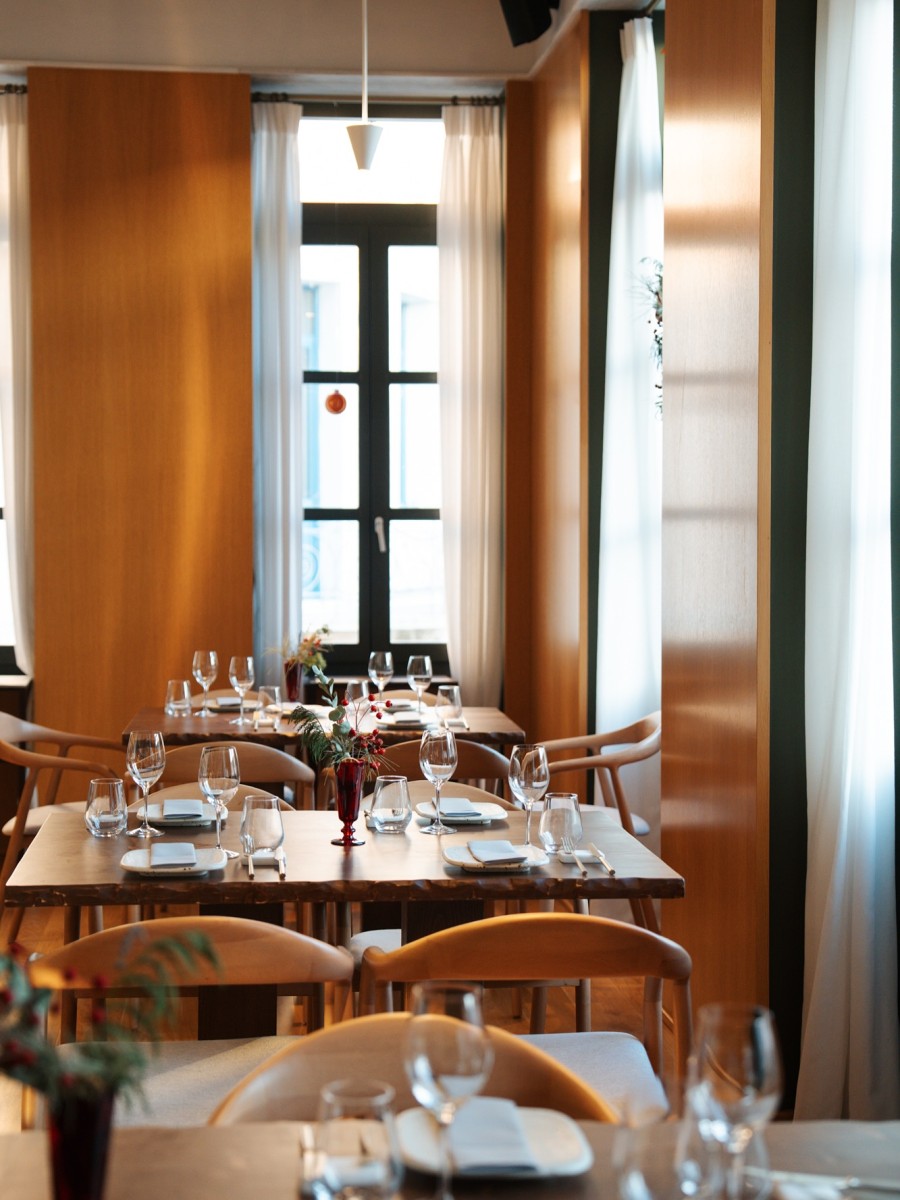
Ydoron is, in essence, a fish steakhouse with a clear focus on dry ageing, a concept that introduces a radically different way of thinking about seafood to Athens. The idea is not built around freshness in its narrow, immediate sense, nor does it aim for a light interpretation of fine dining. Instead, everything here begins with a deep understanding of time as a tool for flavour.
Over the past decade and more, the conversation around how fish can mature has shifted significantly, largely due to the work of Josh Niland, the Australian chef who brought an entirely new approach into the spotlight. Through his work at Saint Peter and Fish Butchery in Sydney, Niland demonstrated that fish can possess depth, structure and longevity, qualities that are revealed through proper ageing rather than through the immediacy of just-caught freshness.
His approach reframed our relationship with seafood, suggesting that flavour develops over time in much the same way it does with meat. It opened the door to a new way of engaging with the marine world, attracting devoted supporters as well as vocal critics, and it is precisely this philosophy that Ydoron brings into an Athenian context, with confidence and clear intent.
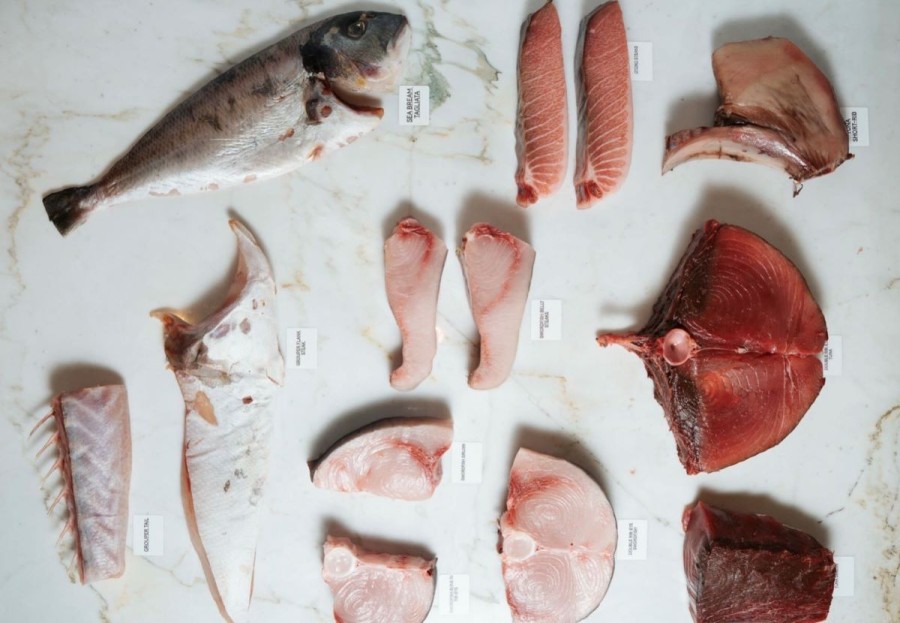
In Greece, however, there were chefs who recognised this potential early on. Marinos Souranis at Marathia in Tinos and Marios Koutsounaris at Mylos by the Sea in Leros have already carved out their own paths around the idea of ageing, through experiments that link technique with landscape, seasonality and Greek produce. Ydoron naturally belongs to this emerging field, yet it brings the technique firmly into the spotlight with a clear, central proposition, and notably within the heart of the city.This is also the framework within which the talented chef Nikos Apostolakis operates, with an approach that begins in careful study and reaches the plate with precision. Dry ageing at Ydoron is applied under clearly defined conditions and total control: temperature, humidity, airflow and time. Each fish follows its own rhythm, each cut develops its own profile. At the beginning of the meal, the chef arrives at the table with a trolley displaying the available cuts, a gesture that genuinely recalls a steakhouse. The guest sees, learns, chooses. In this way, the experience begins at its very foundation.
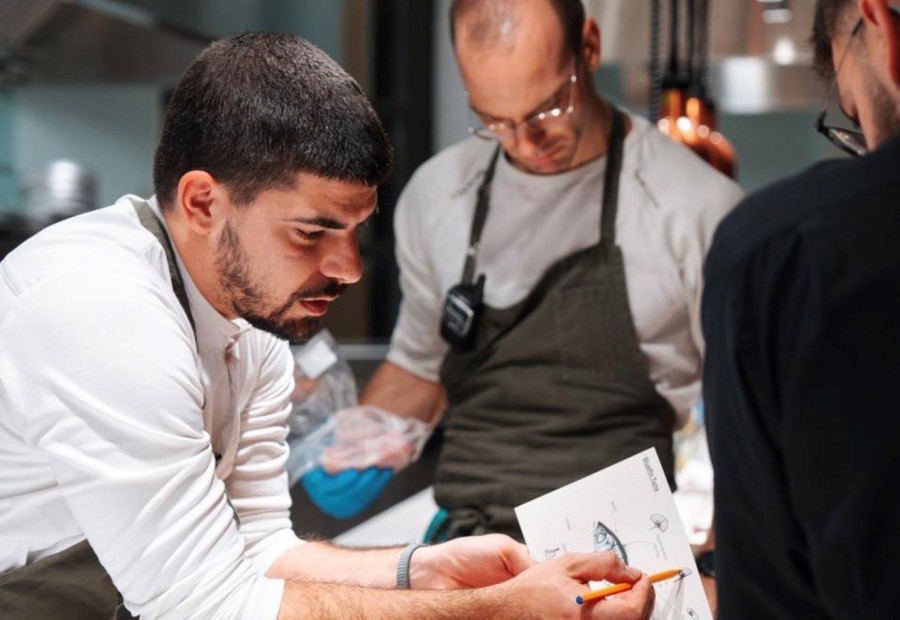
Ydoron has been open for just three months, yet the level of its cooking already shows a consistency that is rare at such an early stage. There is a clear commitment to its philosophy, strong technical discipline, and a team that appears to work with focus and care. Everything suggests that the restaurant has the foundations to move quickly to the next level, both gastronomically and in overall assessment, provided it continues at the same pace and without compromise.
Personally, I found it helpful to think of the experience in two distinct parts: the cuts, which are unquestionably the core of the concept, and the starters, which work in support of that core. The cuts are the restaurant’s great strength. This is where knowledge, respect for the raw material, and a confident handling of time become immediately apparent. The fish shows texture, depth, and a clear sense of character that comes from controlled ageing and precise cooking. I tasted 30-day aged swordfish, 10-day aged gilt-head bream, and 25-day aged dusky grouper, three cuts with clearly defined personalities. The swordfish had a dense, firm texture and real depth of flavour. The sea bream was lighter and more refined, with a delicate aroma and careful cooking that brought out the crispness of the skin. The grouper offered dense flesh, a restrained yet full flavour, and a pleasing length on the palate. The starters, on the other hand, reveal interesting ideas and in several cases succeed in shifting the rhythm of the meal towards something more creative and lighter. There are dishes that already stand out, such as the excellent daska tartare, minced to order at the table, and others that still need refinement, like the somewhat overworked salad with buckwheat, beluga lentils, beetroot, and blue crab.