




The truth is that I had not come to the Portuguese capital in search of yet another good restaurant. In a city where one can eat reasonably well on almost every corner, I was interested in something different. I wanted to understand how fado works within a dining room. Is it simply the musical backdrop to a dinner, or can it genuinely shape the way one experiences the food?
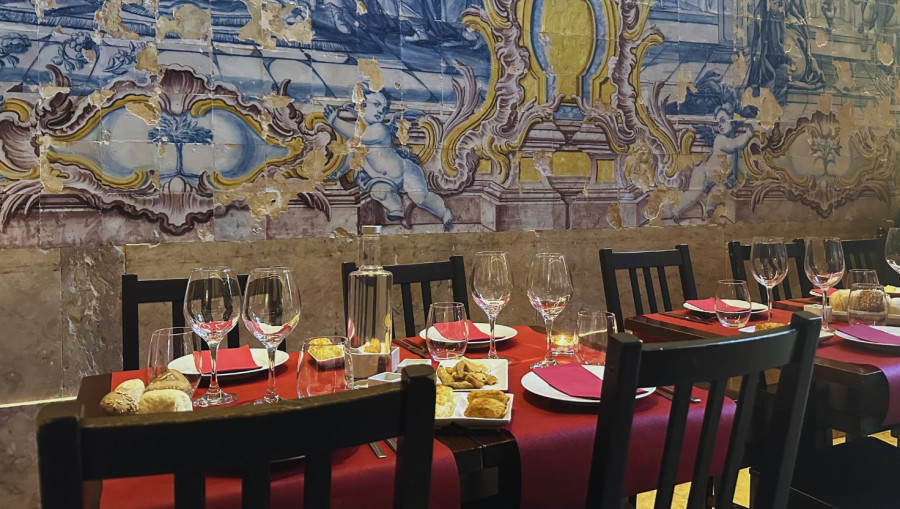
The setting appears ideal. The restaurant is housed in an 18th-century royal chapel, a space with enough history to put you in a favourable frame of mind before you have even sat down at the table. Characteristic Portuguese tiles cover the walls, while the roughly 35 guests that evening are seated almost on top of one another. It is certainly not the most comfortable arrangement I have encountered, but at that moment, learning in detail what is preoccupying the people beside me seems a small price to pay for an authentic night of fado.
The menu begins with a trio of starters that serves as a brief introduction to Portuguese cuisine: pastry filled with goat’s cheese and honey, the expected salt-cod croquettes and peixinhos da horta, crisp tempura-style green beans. All three are entirely forgettable. For my main course, I choose the beef fillet, taking it as a good sign that someone actually asks how I would like it cooked.
The first warning signs appear in the glasses. The waiters move constantly between the tables, refilling whatever they find empty in front of them, often without seeming to know exactly what the glasses had contained before. In this way, a glass of white wine might quite naturally be followed, in the same glass, by vinho verde. Not as part of any structured wine pairing, but simply because no one seems to be keeping track of what each guest has ordered, or particularly to care.
The situation becomes stranger still when a lady at the neighbouring table politely asks what wine she is drinking. The waiter laughs and replies that, if she likes, she can call it vodka, or even gin. The joke produces an awkward smile, but it does not answer the question. The lady never finds out what is in her glass, and I am not entirely sure the waiter knows either.
Up to that point, the evening seemed to be turning into yet another story of mediocre service in a striking setting. Then the musicians began to appear.
Fado was born in Lisbon’s working-class neighbourhoods in the early 19th century, long before it acquired the aura that surrounds it today. For decades, it remained far from concert halls and theatres, living instead in taverns, small drinking houses and private homes, where people gathered to eat, drink and share stories. It became a way of telling stories about love, loss, longing and the famous saudade, a word the Portuguese often insist cannot truly be translated into any other language.
The evening begins with two musicians. And it is at this point that any possible comparison with our own little tavernas with live music collapses. Here, there are no groups quietly singing along, no one getting up to dance between the tables. As soon as the music begins, the room changes its behaviour. Cutlery is set down, conversations stop and all attention turns to the performers. For many Portuguese people, it is still considered rude to continue eating while a song is being performed, and applause is generally reserved for the end of a piece. There are no microphones and no speakers, only the two musicians, a voice and the acoustics of the room. Every word reaches the furthest corner clearly. The tiles that line the walls, the low ceiling and the architecture of a three-century-old chapel create a natural resonance that makes the space function almost like a musical instrument.
For the first time that evening, I stopped thinking about the service.
The rhythm of the evening is simple. The musicians appear, perform three songs and leave. For a few minutes, the room returns to normality. Forks resume their work, glasses are refilled with whatever happens to be at hand, conversations begin tentatively, and then, a little later, everything stops again as the musicians return. Somewhere between two such intervals, my main course arrives. The fillet I had ordered is noticeably more cooked than I had requested. It is not, of course, the end of the world, but looking down at my plate, I cannot help imagining the waiter asking how I would like the meat cooked, then absent-mindedly scribbling on his notepad while pretending to write it down.
By that point, I had accepted the reality of the evening. As a restaurant, it was unlikely to win me over. The service hovered somewhere between chaotic and comic, while the food seemed incapable of justifying the experience on its own. If anything was going to save the situation, it was standing a few metres away. The large wooden front door closes. Beside the musicians stands a woman dressed in black, and she begins to sing.
Time stops.
I do not know whether this is because of fado itself or because of this particular performer. What I do know is that, within a few seconds, she manages to achieve something that had seemed impossible until that point. She makes the restaurant around her disappear: the tables, the plates, the glasses, the irritations and all the disappointments.
Across from me, a woman discreetly wipes her eyes. She is not the only one. Around us, there is absolute silence. Whether one knows anything about music or has simply wandered in by chance, everyone is transfixed. For the first time, I began to think that perhaps I had been asking the wrong question. The issue was not whether music could save the food. The issue was whether, in certain cases, the food is simply the setting for something else.
The pattern continues until the end of the evening. Three songs, a short interval, and me having long since abandoned my food while fondly recalling meals from motorway service stations that, at that particular moment, seemed several classes above what was in front of me. The final blow comes with dessert: a tiny quenelle of chocolate mousse with pink peppercorn, presumably intended to lend an air of thoughtful flavour pairing.
When the large wooden door opens again and the last guests begin to spill out into the narrow streets of Alfama, the question with which I had arrived remains unanswered. Or at least, so I think.
Can music redeem mediocre food and poor service?
The answer is yes. Up to a point.
It can make you forget an overcooked piece of meat. It can make you forgive a waiter who does not know what wine he is serving you. It can even make you laugh at someone who introduces himself as an “assassin” while holding a butter knife. What it cannot do is turn a bad restaurant into a good one.
If someone asked me today whether I would return for the food, the answer would certainly be no. If they asked whether I would return to hear that voice again inside an 18th-century chapel, I would answer before they had even finished the question. And perhaps that is the greatest compliment I can pay this particular restaurant.
Info: https://mesadefrades.pt/
- 0 - 4
- Poor
- 4.5 - 5
- Average
- 5.5
- Acceptable
- 6 - 6.5
- Good
- 7 - 7.5
- Very Good
- 8 - 8.5
- Outstanding
- 9 - 10
- Excellent
| 0 - 4 | 4.5 - 5 | 5.5 | 6 - 6.5 | 7 - 7.5 | 8 - 8.5 | 9 - 10 |
| Poor | Average | Acceptable | Good | Very Good | Outstanding | Excellent |
| *"arrow-symbol": the up arrow to the right of the rating, if it appears, symbolizes a restaurant that is close to moving up to the next ranking rung. | ||||||



Login or register to join the conversation