


We began with current affairs, though off the record. René Redzepi’s name naturally came up in conversation, following everything that has been written recently about Noma and what comes next for it. A few hours earlier, he told me, he had received calls from Greek television programmes asking him to comment on the situation, but he chose not to.
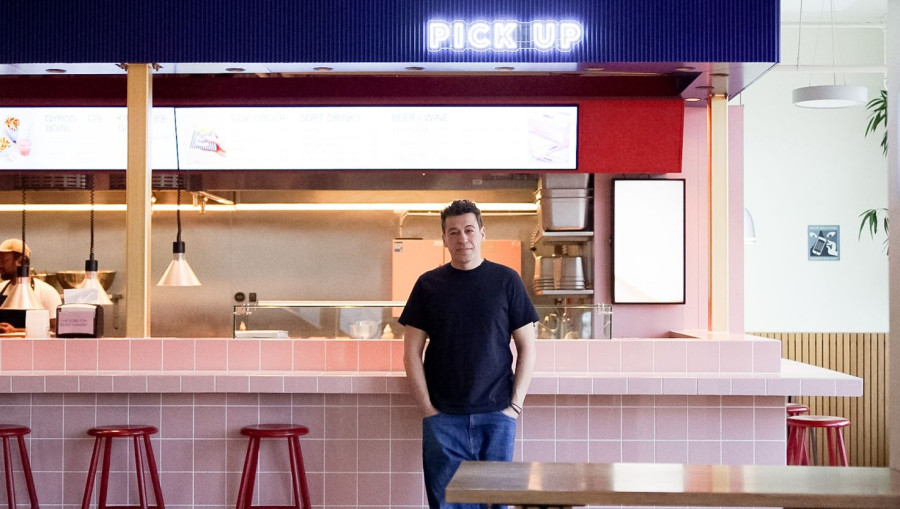
From there, the conversation unfolded amid the bustle of Tivoli Food Hall, with people constantly passing by, while I tucked into one of the tastiest chicken gyros I have ever had. Which felt entirely surreal, considering it was all happening in the heart of Copenhagen.
How does someone who started out in high-end patisserie end up behind a gyros street-food project in Copenhagen?
Via Mykonos, but let’s take things from the beginning. I have been living in Copenhagen for the past 23 years. Ever since I was a student, my goal was to work at the best restaurant in the world. And since we were talking about Noma earlier, I should tell you that in 2006 they offered me a position there, but I turned it down because my daughter had just been born. At the time I was working at Era Ora, then known as one of the most acclaimed Italian restaurants outside Italy, with a Michelin star to its name. I stayed there for six years, and then opened my own patisserie.
After several years spent in kitchens, under pressure and surrounded by shouting, in 2016 Nammos asked me to do some consulting work. So there we were, sitting on a beach with my wife, when she said to me: “How much longer are you going to work from morning until night? How much longer are you going to go on not looking after yourself?”
Was that the moment that changed your path?
It is all part of what happens to people who work in haute cuisine. It is a bug you either have or you don’t. You don’t really think about what is going on around you. You just work, constantly trying to reach the next, higher peak.
So it was in Mykonos that the idea of souvlaki first came to me, when I started thinking about how I wanted my life to continue. Denmark was very fertile ground for that. Danes love trying new things, they travel to Greece often, and they love the country.
Was the move from patisserie to a street-food project an easy decision?
In 2018, I was approached by the street-food market at Noma about doing something with gyros, but my pastry chef’s pride wouldn’t let me. I couldn’t imagine myself, on the one hand, appearing on television and, on the other, opening a food truck. I hesitated. A year later, though, the offer came again, and I thought, let’s give it a try. Today we are still in the same spot, and it is one of the five locations where the project now operates. We serve thousands of souvlaki, and in 2028 a new site is set to open at Copenhagen Airport.
Do you ever miss the world of fine-dining kitchens?
What made you leave patisserie behind?
In everyday life, you realise that dessert is not a priority. I would devote all my attention to a single dessert for days, and when I sold it, everyone would complain about the price. At the same time, you can sell a portion of french fries for the same price and no one says a word. So you come to understand that, professionally, the world of pastry is a very difficult one.
In a strict gastronomic city like Copenhagen, how do people respond to a popular Greek street food?
The inspiration is Greek, because that is how I grew up. But here it is shaped by everything I have carried with me from the past thirty years in kitchens. The chicken you eat here is free-range, we cook it sous vide, we use no preservatives, and then we simply finish it on the grill. It is a different approach to gyros, one that fits very well with Danish culture, but seen through my own lens.
Could a project like this work in Greece too?
Under the right conditions, yes, but you have to communicate it properly. I often think about the fact that people sell a burger for €10 and a gyros pita for €4. Of course, if you buy frozen gyros, you can sell a souvlaki for €3.50, but who says that free-range or organic chicken is cheaper than the minced meat used to make a burger? If something costs more, and if that cost is justified, then that needs to be communicated. We shouldn’t place all products under the same price point simply because they belong to the same category of food. Quality varies enormously. One burger is not the same as another burger, and the same is true of souvlaki. Do you now find street food more interesting than fine dining? Definitely, as long as it has a vision. I love Spanish cuisine and I’m crazy about tapas. You go to Madrid and taste simple things that are so full of flavour. For me, that is what fine dining is now: finding and eating simple, exceptional ingredients. I went to the Azores, and when I tasted the tuna there, I thought, I don’t need anything else in life. For me, it all comes down to the ingredient, and to the intention behind someone’s street food. With the constant bombardment of complex food imagery on social media, I think we need to taste simplicity again. That is why, in my view, there has been such a rise in bistros and street food. Would you ever dare to make a souvlaki adapted to Danish cuisine? No, souvlaki is Greek. You know, when I was working at Era Ora years ago, it was the beginning of the Danish gastronomic movement. Noma was just getting started, foams were at their peak at El Bulli in Spain, but our chef, Elvio, who was an incredible character, used to say: we are Italian. He would bring in chickpeas from Calabria and tomatoes from Vesuvius, because he was authentic and faithful to his own style. Back then, all the chefs were saying, what is he doing? And now everyone does it. So no, I wouldn’t change anything about souvlaki. Perhaps one small addition to give it umami, but that’s as far as I would go. If you had to pair three musical genres with three ingredients, chocolate, vanilla and caramel, what would they be? Chocolate is rock ’n’ roll, because it is multidimensional in terms of structure, handling and flavour. Vanilla is probably a sensual blues track. In its aroma, its presence and its flavour, it is all love and romance. As for caramel, I would say it leans more towards Greek laïko music. You live in a country where micro-bakeries have been thriving for years. How do you feel about that movement now gaining real momentum in Greece too? It’s fantastic. I love this kind of place. I’ve tried many, such as Neropistolo and Kora, which, for example, would cause a sensation if it were in Copenhagen. Many of the people involved in this new trend are doing excellent work, and the public is embracing it. If the time has come to move away from industrial bread, then why not? Let’s put our hands back in the dough.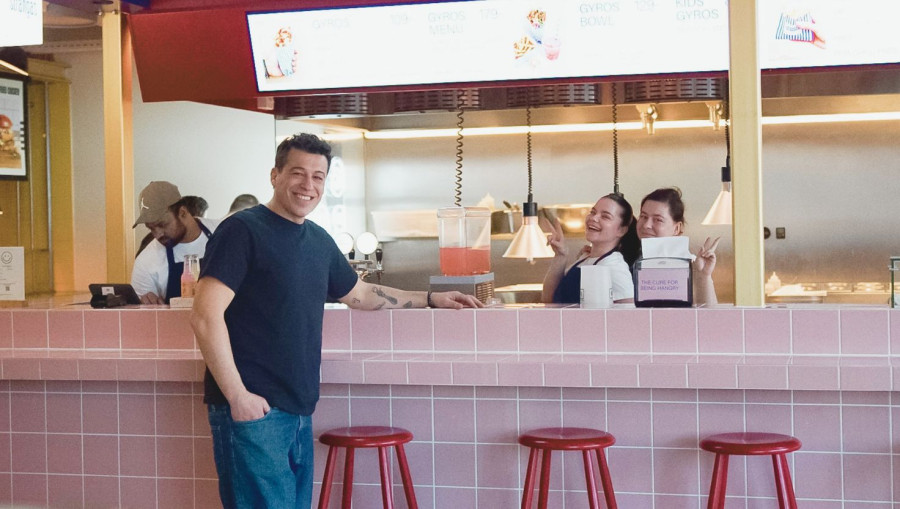
I walked back from Tivoli Food Hall to my hotel. On the way, I found myself thinking that Nikolas Strangas had left the kitchens of high gastronomy behind, but he did not speak about it like someone who had abandoned something. Rather, he spoke like someone who had reconsidered what real success means. From high-pressure kitchens and patisserie, he found himself serving gyros in one of Europe’s most demanding gastronomic cities, without feeling that he had taken a step backwards.
Perhaps because progress is not always measured in stars and accolades, but in whether you get to see your family, whether you enjoy what you make, and whether you can still speak about food with passion.
Photography: Savvas Stanis


Login or register to join the conversation