



There is something insistently Parisian about the idea of bistronomy. A model that began as a form of resistance and, over time, became a tradition in its own right. It emerged from a simple need: food grounded in technique and clarity, using more modest ingredients yet offering genuine creative depth, all without the formality and rigid codes of haute gastronomy.
Many assumed that bistronomy would eventually lose momentum, that Paris would remain forever incurably classical and gastronomically monumental. That assumption has proved misplaced. The city has kept bistronomy alive precisely by allowing it to evolve. What is most compelling today is this shift: the bistronomic form remains unmistakably Parisian, but its content is becoming increasingly polyphonic. Cuisines that once entered Paris as “exotic” footnotes now appear to be finding their own voice, and doing so to an enthusiastic response from a new generation of diners.
It was within this climate that Orson arrived on the rue du Dragon, and it began to generate conversation even before the charcoal was lit and the key turned in the door. After all, the quietly charismatic and evidently talented Esu Lee had already made a significant impact in Paris with JIP. With Orson, he set out to do something more overtly personal, transforming memory into something both unexpected and deeply familiar.
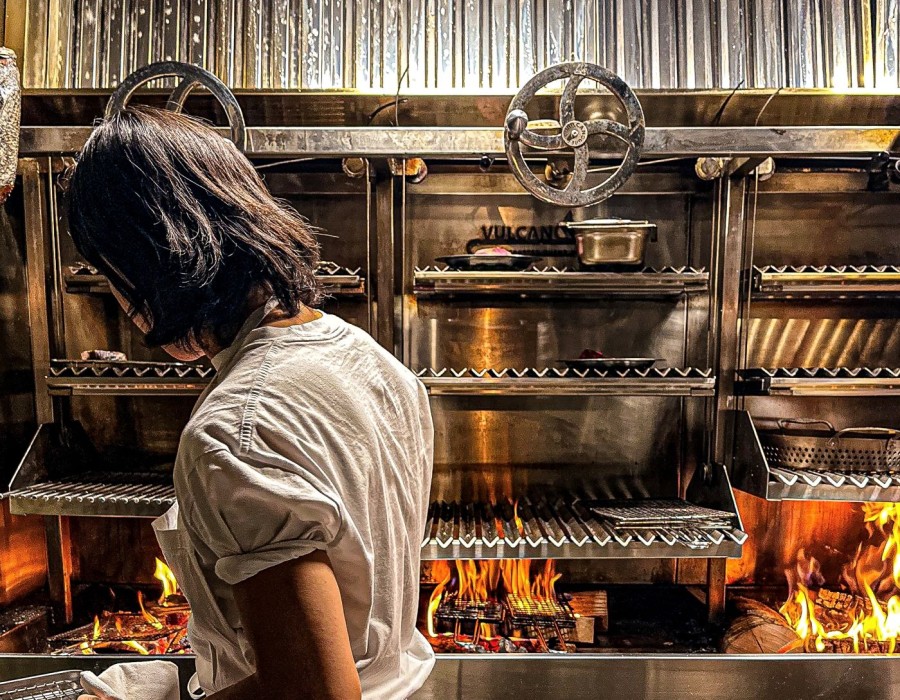
The restaurant itself is small but impeccably judged. Warm wood, soft shadows and subtle metallic highlights create a space that feels intimate without being precious. At the back of the room sits the restaurant’s raison d’être, a monumental, custom-built grill. Fire is the central idea here. This is not simply an open kitchen designed for visibility, but the axis around which the entire experience is organised. Wheels, levers and polished steel surfaces give the grill an air of industrial precision, immediately signalling Orson’s core language of cooking: fire as the primary means of expression. Most intriguing of all, however, is a technical detail that functions as a quiet signature. A water-cooling system designed to control smoke, allowing intensity and clarity to coexist without overwhelming the room.
Esu Lee’s cooking is anchored in something very specific: the warmth and generosity of Korean family meals, refracted through a Parisian, bistronomic lens. The menu is offered as a tasting sequence in four “acts”, comprising around fifteen dishes, several of which are designed to be shared at the centre of the table. At €86, the price is a statement in itself for Paris. There are many dishes worth mentioning, but I will focus only on those that particularly caught my attention. I visited on the restaurant’s opening night, and I am conscious that this is still a work in progress, as it should be. At such an early stage, what stands out most is that Orson already feels clearly oriented. There is intent here, and a sense of direction that suggests a kitchen confident in the path it wants to follow.
The opening stage is essentially a table of small bites designed for sharing, something akin to Korean banchan, but composed with Parisian elegance. It begins quietly and deeply with salsify in chicken jus and cured egg yolk, before building intensity with bulot in fermented lovage and beef jerky paired with Sichuan mayonnaise. It closes on a high note with kimbap, alongside aged sériole and shimesaba mackerel with house-made yuzu kosho. Clean, iodised flavours, carried by a fine, controlled heat that keeps the palate alert.
The Galician mussels with Indonesian sambal stood out in particular. Punchy yet layered, their saline intensity dovetails beautifully with the mussels’ natural sweetness. The wagyu bavette was also outstanding. Here, the influence of the grill is unmistakable, lending the meat a silky texture and precise char. The vegetables follow the same logic, shaped by flame, smoke and texture rather than garnish.
What I appreciated most about Orson is that the kitchen knows exactly where it comes from and is unafraid to articulate that identity on its own terms. If you find yourself in Paris and are looking for something genuinely interesting, contemporary and entirely relaxed, this is a table worth seeking out. Just be sure to book ahead.
Info: https://www.orson.paris/- 0 - 4
- Poor
- 4.5 - 5
- Average
- 5.5
- Acceptable
- 6 - 6.5
- Good
- 7 - 7.5
- Very Good
- 8 - 8.5
- Outstanding
- 9 - 10
- Excellent
| 0 - 4 | 4.5 - 5 | 5.5 | 6 - 6.5 | 7 - 7.5 | 8 - 8.5 | 9 - 10 |
| Poor | Average | Acceptable | Good | Very Good | Outstanding | Excellent |
| *"arrow-symbol": the up arrow to the right of the rating, if it appears, symbolizes a restaurant that is close to moving up to the next ranking rung. | ||||||



Login or register to join the conversation