



You never pass up the chance to taste Piedmont, especially when it involves two small, perfectionist producers. Even more so when that opportunity comes in the depths of winter, a season inseparable from this great wine region of north-western Italy, forever associated with cold air, thick fog and the comforting pull of a lit fireplace.
The Giovanni Rosso estate traces its roots back four generations, with documented activity in the area since 1906. Today, the winery is steered by Davide Rosso, who, while expanding his horizons in 2016 to the volcanic slopes of Mount Etna, has never shifted the true centre of gravity of the domaine. Its heart remains firmly anchored in Barolo, and more precisely in Serralunga d’Alba, one of the appellation’s most structured and age-worthy terroirs.
Of course, the range also extends beyond Barolo to include wines from different areas and grape varieties across Piedmont. One of the most recent additions is the white Roero Arneis, presented here as Roero Arneis DOCG 2023 (7.5/10).
Arneis often shows a deeper yellow hue that can misleadingly suggest a lack of freshness. In reality, the opposite is true. The moderately expressive nose is led by mandarin and sweet grapefruit, with hints of lychee liqueur lending a subtle tropical accent. The palate mirrors this interplay of sensations: on one hand, a velvety roundness; on the other, a distinctly Alpine sense of freshness, driven by a finely judged acidity that carries through to the finish.
Donna Margherita 2023 (8/10) is a Barbera d’Alba, and as such is theoretically expected to be fuller and firmer than a comparable expression from Asti. In practice, only the first assumption holds true. This red, matured in 5,000-litre foudre, is remarkably supple and well balanced. Drinking beautifully now, it reveals sweet spices, plum and subtle herbal notes, finishing with impressive poise. Add to that a very reasonable €20 price tag, and the appeal is hard to ignore.
The producer offers several Barolo cuvées, one of which is the Barolo del Comune di Serralunga d’Alba 2020 (8.5/10). Sourced exclusively from vineyards within the renowned commune of Serralunga d’Alba, the wine is fragrant with red fruit, ash and violet, forming a dense yet ethereal whole. While it will comfortably carry on into the next decade, it is already silky in tannin and gentle on the palate. Sweet spices sign off the finish, underlining Giovanni Rosso’s ability to bring a sense of calm and refinement even to the inherently powerful Nebbiolo.
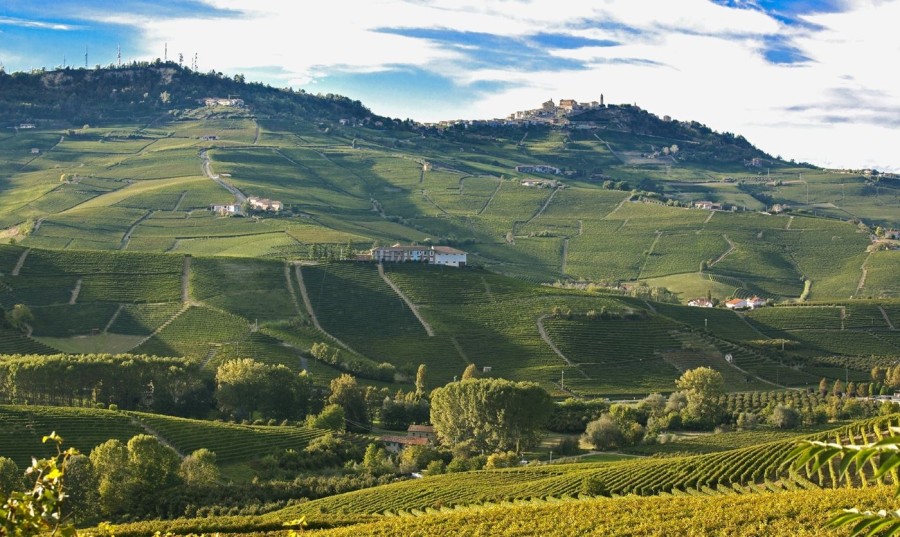
With family roots stretching back to the 17th century, Gigi Pipa was among the most uncompromisingly traditional winegrowers in Piedmont. He famously crushed grapes by foot and resisted the use of modern winemaking equipment. From the 1980s onwards, the storied Boschis family carried this vision forward, with Chiara Boschis in particular elevating the wines of E. Pira & Figli to cult status. Today, they are among the most sought-after and difficult-to-find wines in the region.
The style here is more untamed, firmly structured and clearly built for ageing, something already evident in the Dolcetto d’Alba 2023 (8/10). Dolcetto is often regarded as a light, easy-drinking variety, yet this stainless-steel–fermented expression proves that it can be something altogether more serious. The wine showcases vibrant freshness through notes of blueberries and sour cherry, complemented by a touch of herbal character and a pleasantly bitter edge. Its modest alcohol, bright acidity and pronounced tannins tilt the balance towards a more assertive profile, one that will benefit from two to four years in bottle to soften and settle.
Nebbiolo d’Alba 2023 (8.5/10) is, intriguingly, a single-vineyard red that captures the estate’s fresh yet serious style with striking clarity. The classic bouquet unfolds with greengage, tea and hibiscus infusions, and violet, while the palate is notably refined and well balanced. It does not, however, shy away from a firmer statement. The wine’s assertive character is underpinned by the quality of its tannins, shaped through 14 months of ageing in second-use small barrels.
Although Barolo Via Nuova (9/10) takes its name from a small vineyard beside the “new road” that once linked Barolo with Novello, today it is a blend sourced from six vineyards across Barolo, Monforte and Serralunga d’Alba. The result is a refined, aristocratic wine, rich in concentration and expressive notes of ash, minerals and red-black fruit. At the same time, it is unmistakably a Barolo in full command of its identity: abundant acidity and uncompromising, muscular tannins form a structure that calls for at least two decades in bottle before revealing the full breadth of its grandeur.
Piedmont has proven time and again that it can pour both light and shadow into the glass, elegance and severity, the masculine and the feminine. The estates Giovanni Rosso and E. Pira & Figli express this duality with remarkable precision, embodying the yin and yang of one of Italy’s greatest vineyards.
All wines are imported by Constantinou Wines (tel. +30 6977 913515).


Login or register to join the conversation